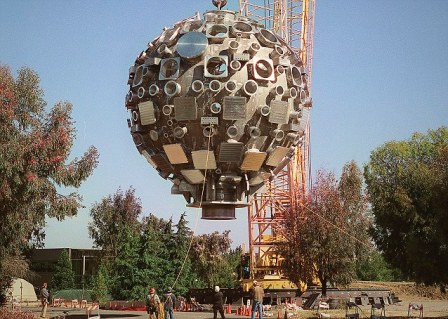
The 'miniature star on earth' will become the world's first sustainable fusion reactor

192 lasers beams at the centre of the reactor will be fired up and aimed them at a glass target containing tritium and deuterium gas (The holes in the chamber which is 10 metres in diameter and covered in 30 cm thick concrete permits the 192 laser beams to enter the chamber.)

The temperature at the centre of the reactor can reach six million degrees Fahrenheit (For a direct comparison, the temperature at the centre of the sun is 27 million degrees Fahrenheit)

Experts predict that reactor could be operational by 2020 and that by 2050 a quarter of U.S. energy could be supplied by fusion power

The reactor could be a miniature sun on earth providing energy for thousands of people when it is working as a power station in 2020
The National Ignition Facility (NIF) in Livermore California, scientists are aiming to build the world's first sustainable fusion reactor by 'creating a miniature star on Earth'.
The process is known as conducting inertial confinement fusion (ICF) and when the reactor eventually goes live it will generate unprecedented temperatures and pressures in the target materials which are held in a tiny glass ball.
The temperatures inside the chamber will be more than 100 million degrees and create pressures more than 100 billion times Earth's atmospheric pressure.
Fusion versus Fision
Unlike with fission power which is utilised at nuclear power stations and has seen accidents such as the 1986 Chernobyl disaster, fusion power is safe and relatively green.
Although fusion is a nuclear process, it also differs from the fission process in that there is no radioactive by-product from the fusion reaction only helium gas and a neutron
Fusion energy is very promising as a long-term future energy source, as the fuels required to generate it are relatively abundant on Earth and the creation of energy is safe and friendly to the environment.
Deuterium is extracted from seawater, and tritium is derived from the metal lithium, a common element in soil.
One gallon of seawater would provide the equivalent energy of 300 gallons petrol, and fuel from 50 cups of water contains the energy equivalent of two tons of coal.
A fusion power plant would be carbon free, as well as produce considerably lower amounts and less difficult-to-store radioactive byproducts than current nuclear power plants.
Also, there would be no danger of a runaway reaction or core ''meltdown'' in a fusion power plant.
Consequently, fusion energy would be beneficial to both the environment and the economy.
Fusion Concept
Current nuclear power plants, which use fission, or the splitting of atoms, to produce energy, have been pumping out electric power for more than 50 years.
But achieving nuclear fusion burn and gain has not yet been demonstrated to be viable for energy production.
For fusion burn and gain to occur, a special fuel consisting of the hydrogen isotopes deuterium and tritium must first 'ignite'.
In the 1970's, scientists began experimenting with powerful laser beams to compress and heat the hydrogen isotopes to the point of fusion, a technique called inertial confinement fusion, or ICF.
The rapid heating caused by the laser "driver" makes the outer layer of the target explode.
In keeping with Isaac Newton's Third Law (for every action there is an equal and opposite reaction), the remaining portion of the target is driven inwards in a rocket-like implosion, causing compression of the fuel inside the capsule and the formation of a shock wave, which further heats the fuel in the very centre and results in a self-sustaining burn known as ignition.
The process is known as conducting inertial confinement fusion (ICF) and when the reactor eventually goes live it will generate unprecedented temperatures and pressures in the target materials which are held in a tiny glass ball.
The temperatures inside the chamber will be more than 100 million degrees and create pressures more than 100 billion times Earth's atmospheric pressure.
Fusion versus Fision
Unlike with fission power which is utilised at nuclear power stations and has seen accidents such as the 1986 Chernobyl disaster, fusion power is safe and relatively green.
Although fusion is a nuclear process, it also differs from the fission process in that there is no radioactive by-product from the fusion reaction only helium gas and a neutron
Fusion energy is very promising as a long-term future energy source, as the fuels required to generate it are relatively abundant on Earth and the creation of energy is safe and friendly to the environment.
Deuterium is extracted from seawater, and tritium is derived from the metal lithium, a common element in soil.
One gallon of seawater would provide the equivalent energy of 300 gallons petrol, and fuel from 50 cups of water contains the energy equivalent of two tons of coal.
A fusion power plant would be carbon free, as well as produce considerably lower amounts and less difficult-to-store radioactive byproducts than current nuclear power plants.
Also, there would be no danger of a runaway reaction or core ''meltdown'' in a fusion power plant.
Consequently, fusion energy would be beneficial to both the environment and the economy.
Fusion Concept
Current nuclear power plants, which use fission, or the splitting of atoms, to produce energy, have been pumping out electric power for more than 50 years.
But achieving nuclear fusion burn and gain has not yet been demonstrated to be viable for energy production.
For fusion burn and gain to occur, a special fuel consisting of the hydrogen isotopes deuterium and tritium must first 'ignite'.
In the 1970's, scientists began experimenting with powerful laser beams to compress and heat the hydrogen isotopes to the point of fusion, a technique called inertial confinement fusion, or ICF.
The rapid heating caused by the laser "driver" makes the outer layer of the target explode.
In keeping with Isaac Newton's Third Law (for every action there is an equal and opposite reaction), the remaining portion of the target is driven inwards in a rocket-like implosion, causing compression of the fuel inside the capsule and the formation of a shock wave, which further heats the fuel in the very centre and results in a self-sustaining burn known as ignition.